
Common English Grammar Mistakes and How to Correct Them
Have you ever started speaking English confidently, only to hesitate because you are unsure whether your sentence is grammatically correct? From confusing verb tenses to using the wrong prepositions, small mistakes can affect how clearly you communicate. The good news is that most common English grammar mistakes can be corrected with regular practice and a better understanding of sentence structure.
Whether you are preparing for a job interview, communicating with colleagues or improving your everyday conversations, good grammar can help you express yourself more clearly. Many learners in the UK choose structured lessons, including Online spoken English classes UK, to practise grammar alongside speaking, listening and pronunciation.
In this guide, we will explore ten common English grammar mistakes, explain how to correct them and share practical tips to help you speak and write more confidently.
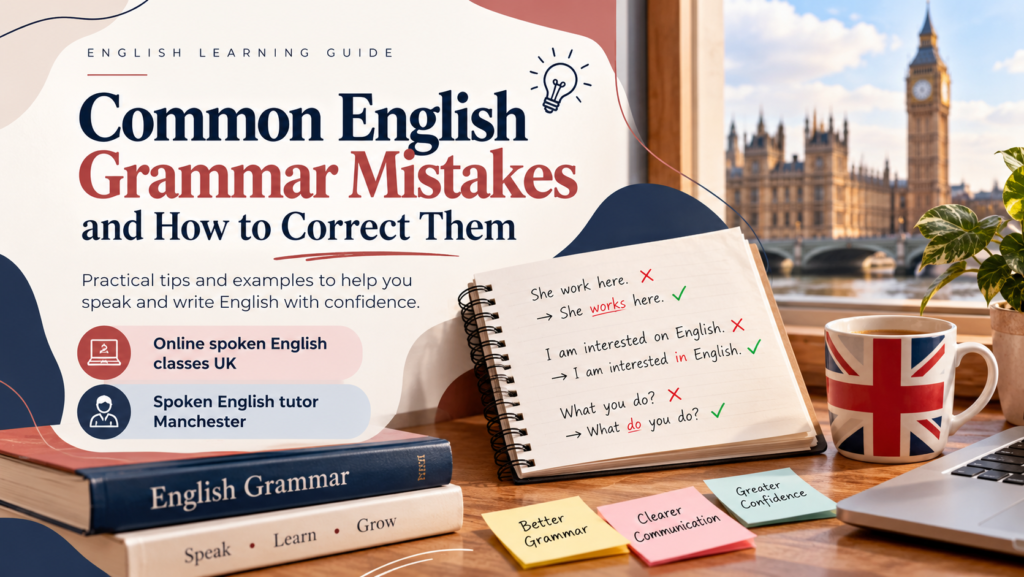
Why Do English Learners Make Grammar Mistakes?
Grammar mistakes are a normal part of learning a language. Some learners translate sentences directly from their first language, while others understand grammar rules but struggle to apply them during a conversation.
For example, you might say, “She work in Manchester” instead of “She works in Manchester.” The meaning is understandable, but the verb needs correcting.
The best way to improve is to identify your recurring mistakes, learn the relevant rules and practise using the correct forms in everyday situations. If you need personalised guidance, working with a Spoken English tutor Manchester learners can access online or in person may help you identify specific areas for improvement.
10 Common English Grammar Mistakes and How to Correct Them
1. Subject-Verb Agreement
Subject-verb agreement means using a verb that matches its subject.
Incorrect: She work in an office.
Correct: She works in an office.
In the present simple tense, we generally add -s or -es to the verb when the subject is he, she or it.
More examples:
- Incorrect: He live in London.
- Correct: He lives in London.
- Incorrect: My brother play football every weekend.
- Correct: My brother plays football every weekend.
Tip: When talking about regular activities, check whether your subject is he, she or it before choosing the verb form.
2. Confusing Present Perfect and Past Simple
Choosing the correct tense is important when describing past events and experiences.
Incorrect: I have visited London last year.
Correct: I visited London last year.
Use the past simple for completed actions at a specific time in the past. The present perfect is often used for experiences or past actions connected to the present when no finished past time is specified.
Examples:
- I went to Birmingham last weekend.
- I have visited Birmingham several times.
- She finished her assignment yesterday.
- She has already finished her assignment.
Tip: Words such as yesterday, last week and in 2024 generally call for the past simple when describing a completed event.
3. Using the Wrong Prepositions
Prepositions are small words that help explain relationships between people, places, times and ideas. However, they can be difficult to learn because many expressions follow established patterns.
Incorrect: I am interested on learning English.
Correct: I am interested in learning English.
Other examples include:
- Incorrect: I am good in English.
- Correct: I am good at English.
- Incorrect: It depends of the weather.
- Correct: It depends on the weather.
- Incorrect: I am waiting you.
- Correct: I am waiting for you.
Tip: Learn common word combinations together, such as interested in, good at, depend on and wait for. This is particularly useful when practising everyday spoken English.
4. Forgetting Articles: A, An and The
Articles often cause confusion, especially for learners whose first language uses different grammatical structures.
Incorrect: She is teacher.
Correct: She is a teacher.
Use a or an with a singular countable noun when referring to something non-specific. Use the when referring to something specific or already known.
Examples:
- I bought a book yesterday.
- The book is about English grammar.
- He ate an apple.
- She works in a hospital.
Remember that a and an depend on the initial sound rather than simply the first letter. For example, we say a university but an hour.
Tip: Whenever you use a singular countable noun, check whether it needs an article.
5. Confusing Much and Many
Both words refer to quantities, but they are used with different types of nouns.
Incorrect: I have many work to do.
Correct: I have much work to do.
In everyday conversation, “I have a lot of work to do” is also a natural and widely used alternative.
Examples:
- How many books do you have?
- How much time do we have?
- There are many people at the station.
- I do not have much money with me.
Tip: Use many with countable plural nouns and much with uncountable nouns. Practise the distinction in complete sentences rather than memorising isolated rules.
6. Making Questions with Incorrect Word Order
English questions often require an auxiliary verb before the subject.
Incorrect: Where you are going?
Correct: Where are you going?
More examples:
- Incorrect: What you do for a living?
- Correct: What do you do for a living?
- Incorrect: Why she is late?
- Correct: Why is she late?
- Incorrect: You like coffee?
- Correct: Do you like coffee?
Tip: Practise common question structures aloud. Questions such as “Where do you live?”, “What are you doing?” and “Could you help me?” are useful in everyday conversations and professional situations.
7. Using Incorrect Negative Forms
English negatives require the correct auxiliary verb and sentence structure.
Incorrect: I no understand.
Correct: I do not understand.
Other examples:
- Incorrect: She don’t like coffee.
- Correct: She doesn’t like coffee.
- Incorrect: He didn’t went to work.
- Correct: He didn’t go to work.
After didn’t, use the base form of the main verb. Therefore, we say didn’t go, not didn’t went.
Tip: Practise the patterns do not, does not and did not with the correct verb forms.
8. Confusing Your and You’re
Some mistakes occur because two words sound alike but have different meanings.
Incorrect: Your welcome.
Correct: You’re welcome.
Your indicates possession, while you’re is a contraction of you are.
Compare these examples:
- Your bag is on the chair.
- You’re very helpful.
- Their house is near the station.
- They’re coming to the meeting.
- It’s going to rain.
Tip: Replace you’re with you are to check whether the sentence makes sense. This simple technique can also help you distinguish between their and they’re.
9. Confusing Make and Do
The verbs make and do appear in many common English expressions, but they cannot always be used interchangeably.
Incorrect: I did a mistake.
Correct: I made a mistake.
Other useful expressions include:
- Make a decision.
- Make an effort.
- Do your homework.
- Do your best.
- Do the shopping.
- Make a cup of tea.
These word combinations are known as collocations. Learning them can make your English sound more natural.
Tip: Write short sentences using expressions such as make a decision and do your best. Practising complete phrases helps you remember the correct combinations.
10. Using the Wrong Verb Form After Another Verb
Some verbs are followed by an -ing form, while others take a to-infinitive.
Incorrect: I enjoy to read books.
Correct: I enjoy reading books.
Compare the following examples:
- I enjoy learning English.
- She wants to improve her pronunciation.
- They decided to leave early.
- He avoids speaking in public.
- We hope to visit Scotland.
Tip: Keep a list of useful verb patterns and practise them in sentences about your daily routine, work and personal interests.
How to Improve Your English Grammar in Everyday Life
Understanding grammar rules is only the first step. To use them confidently, you need to practise applying them in real situations.
Read English Every Day
Read British news articles, short stories, books and educational resources. Pay attention to sentence structure, verb tenses and common expressions.
You do not need to understand every word. Focus on noticing useful patterns and how they are used in context.
Listen to Natural English Conversations
Listen to British podcasts, interviews and educational videos. Notice how speakers form questions, connect ideas and use everyday expressions.
Repeating short sentences aloud can help you become more familiar with natural sentence patterns.
Keep a Personal Grammar Notebook
Whenever you make a mistake, write down the incorrect sentence, its corrected version and a short explanation.
For example:
- Incorrect: She don’t work here.
- Correct: She doesn’t work here.
- Rule: Use doesn’t with he, she and it in the present simple negative.
Review your notes regularly to identify patterns in your mistakes.
Practise Speaking Regularly
You may answer grammar questions correctly on paper but still struggle to use the same structures during a conversation. Speaking requires you to think, organise your thoughts and respond quickly.
Describe your day aloud, practise interview questions or record yourself speaking for two minutes. Listen to your recording and identify areas you could improve.
For learners who need a structured routine, Online spoken English classes UK can offer opportunities to practise conversations, receive feedback and work on grammar in context. Look for lessons that combine explanations with practical speaking activities rather than focusing exclusively on written exercises.
Get Personalised Feedback from an English Tutor
Sometimes, you may not notice your own mistakes. A tutor can help identify recurring problems and explain how to correct them.
If you are based in Manchester, looking for a Spoken English tutor Manchester learners can work with may be useful when you want individual attention, conversational practice or support with workplace communication.
Before choosing a tutor or course, consider your current level, learning goals, lesson format and availability. Regular feedback can help you focus on the areas that need the most attention.
Why English Grammar Matters in the UK Workplace
Clear communication is useful in job interviews, meetings, professional emails and everyday conversations with colleagues.
Consider this example:
Incorrect: I am working here since two years.
Correct: I have been working here for two years.
The corrected sentence communicates the intended meaning more naturally.
Good grammar can also help you explain ideas, ask questions and understand instructions. However, effective communication involves more than grammar alone. Listening skills, vocabulary, pronunciation and confidence all play important roles.
If you are improving your English for employment, practise introducing yourself, describing your experience, asking for clarification and contributing to discussions. These practical activities help you apply grammar in situations that matter.
Frequently Asked Questions About English Grammar
What are the most common English grammar mistakes?
Common mistakes include incorrect verb tenses, subject-verb agreement errors, missing articles, wrong prepositions and incorrect question structures. Confusing words such as your and you’re is also common.
How can I improve my English grammar quickly?
Start by identifying three to five mistakes you make regularly. Learn the rules, practise corrected examples and review your progress each week. Focused practice is often more effective than trying to learn every grammar rule at once.
Are online spoken English classes useful for adults in the UK?
Yes, they can be useful when lessons match your level and learning goals. When comparing Online spoken English classes UK, look for opportunities to practise conversations, receive constructive feedback and improve grammar through real-life examples.
How can I find a Spoken English tutor in Manchester?
Look for a Spoken English tutor Manchester learners can access through local teaching services or online lessons. Compare the tutor’s experience, teaching approach, availability and student feedback before choosing.
Can I improve spoken English without studying grammar every day?
Yes. Listening, reading, conversation practice and speaking exercises can all support progress. However, learning common grammar patterns can help you recognise mistakes and express ideas more accurately. Combining practical speaking with focused grammar revision is a useful approach.
Final Thoughts
Making grammar mistakes does not mean you are bad at English. It simply means there are areas you can continue to improve.
Start with the basics: practise verb forms, learn common prepositions, understand articles and pay attention to question structure. Then apply these rules in conversations, emails and everyday situations.
If you prefer structured guidance, explore suitable Online spoken English classes UK that combine grammar lessons with practical speaking activities. Learners seeking individual support can also consider a Spoken English tutor Manchester who understands their goals and can provide personalised feedback.
You do not need to become perfect overnight. By practising consistently, reviewing your mistakes and using English in real-life situations, you can gradually communicate more clearly and confidently.